Rules, Services or Incentives: Comparing Policy Tools
Compare policy tools by the change they ask people to make, so you can identify whether a proposal relies on rules, public services, incentives, or a mix.
Is a proposal asking people to obey a requirement, use something the government provides, or change their behavior in response to a reward or cost? Comparing policy tools starts with that question. A proposal’s label may sound broad—“improve road safety,” for instance—but its actual instrument is the lever it uses to prompt change.
That distinction helps readers assess what a policy asks of residents, businesses, and public agencies. It also makes mixed proposals easier to read: a rule can establish a duty, a service can make compliance practical, and an incentive can shift the appeal of one choice over another.
Find the working verb
Start with the proposal’s operative language rather than its title or stated ambition. Look for verbs such as require, provide, subsidize, charge, ban, or offer. Ask who is expected to do what, and what happens if they do—or do not.
A goal such as cleaner air does not identify a tool. “Require factories to limit emissions” points to a rule; “fund transit service” points to a service; “offer a rebate for efficient equipment” points to an incentive. The same goal can be pursued through different instruments, each placing demands on different people and institutions.
Then identify the proposal’s main actor. A requirement usually places a duty on someone regulated; a service makes a public resource available to users; an incentive changes the financial or practical appeal of an action. If a policy contains more than one verb, note each instrument instead of squeezing the whole proposal into one category.
Read rules as duties
A rule sets a standard, prohibition, eligibility condition, or required action. It answers, in effect: what must someone do, or refrain from doing, to meet the public requirement? Examples include licensing conditions, building codes, and limits on particular activities.
To assess a rule, inspect who is covered, what conduct is specified, and how the standard is administered. A rule may be clear in principle but hard to apply if people cannot tell which situations qualify, or if the responsible agency lacks a workable way to check compliance.
Rules can create a common baseline: everyone in the defined group faces the same stated duty. But a duty can also impose different practical burdens. A small organization and a large one may have unequal capacity to meet the same requirement, so the proposal’s supporting guidance, transition arrangements, and enforcement approach matter to the instrument’s real shape.
Do not confuse a rule with the machinery that supports it. Inspections, reporting systems, and penalties are ways to administer or enforce a rule; they do not change the basic fact that the policy asks a covered party to meet a stated requirement.
Read services as provision
A service puts a resource or activity within reach of intended users. It might be a public clinic, a transit route, a job-placement program, or an advice line. The central question is not simply whether government spends money, but what people can actually access and use.
Look for the service’s delivery channel and its user-facing conditions. Is it offered in person, online, through schools, or by a contracted provider? Who can use it, where is it available, and what steps must a person take to receive it? These details reveal whether the proposal gives people a usable option or only announces one.
Services ask public agencies to organize staff, facilities, information, or partnerships. They can help people act without making that action compulsory, but availability alone may not resolve barriers such as inconvenient hours, limited transportation, language access, or confusing enrollment. A proposal that funds a service should make its intended users and mode of delivery legible.
A service can also support a separate rule. For example, a government could require a safety-related action while offering an accessible service that helps people comply. In that case, the rule creates the duty and the service helps meet it; calling the package “a service policy” would hide part of its design.
Read incentives as changed payoffs
An incentive changes the costs or benefits attached to a choice. A grant, tax credit, fee, rebate, or reduced fare can make one action more attractive or less costly. The proposal is not simply providing something: it is changing the terms under which people decide whether to act.
Ask which behavior the incentive targets, who qualifies, and what action triggers it. A rebate available only after a purchase works differently from a grant that helps cover costs in advance. A fee imposed for a specified activity works differently from a reward, even though both alter financial considerations.
Also ask who can respond to the incentive. If people need money up front, time to complete an application, or access to an approved provider, some intended participants may have difficulty taking it up. The instrument’s effect depends partly on whether its terms are usable by the people it aims to influence.
Incentives leave a choice formally open, but that does not mean they are consequence-free. A fee can weigh more heavily on people with fewer alternatives, while a subsidy may be easier for those who can pay first and claim support later. Reading eligibility and payment timing helps make those distributional features visible without assuming a particular result.
Separate mixed proposals
Many proposals combine tools, so classify each operative part before judging the package. A single initiative might set a requirement, provide a service that supports compliance, and offer an incentive for going beyond the required standard. Those components may reinforce one another, but each has a different job.
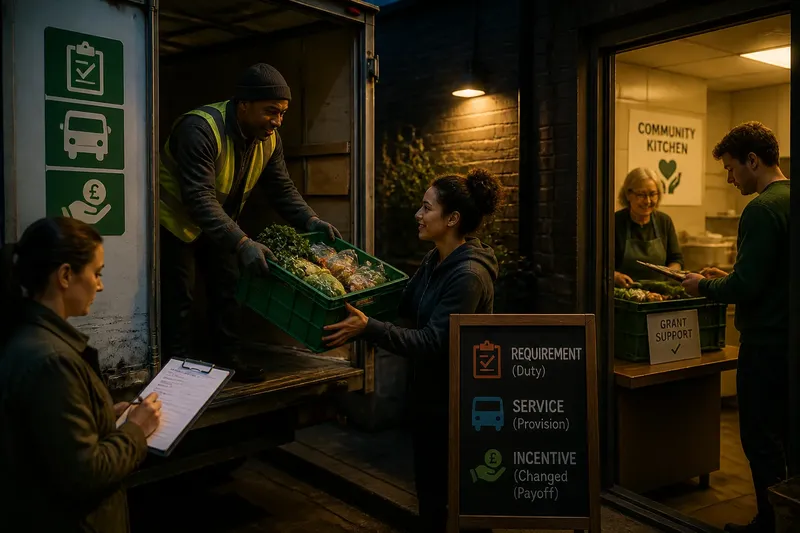
Say a city proposes to reduce household food waste. Imagine its draft requires large food retailers to separate edible surplus, funds a collection service that delivers it to community kitchens, and offers participating kitchens a small grant for refrigeration. The requirement targets retailer conduct, the service handles collection, and the grant changes the resources available to receiving organizations. To understand the proposal, a reader would ask separately how the requirement is defined, where collection is offered, and what grant conditions apply.
This separation also helps catch gaps. A requirement may lack a practical way to comply; a service may be available without reaching its intended users; an incentive may reward an action that the proposal has not clearly defined. These are different design questions, so a single label cannot answer them.
Compare the tools?
What makes a policy tool a rule?
A rule establishes a duty, limit, standard, or condition for a defined group. Look for language that says what people must do or cannot do, and identify how the requirement is administered.
How is a service different from a subsidy?
A service provides an activity or resource for people to use, such as transit or counseling. A subsidy changes the cost of a choice, often by helping pay for a service or purchase; the two can appear in the same proposal.
Can one proposal use all three tools?
Yes. A proposal can set a requirement, provide a public service that helps people meet it, and offer a financial incentive for an additional action.
Which tool is best?
There is no best instrument apart from the problem, intended users, and delivery conditions. Compare what behavior each tool asks for and what capacity agencies and affected groups would need to make it workable.
Make a clean comparison
Before forming a view, write a short description of each instrument in plain language. A useful comparison can fit into a compact set of prompts:
- Tool: Is this a rule, a service, an incentive, or a combination?
- Requested change: What action or choice does it address?
- People involved: Who has a duty, who uses a service, or who can receive an incentive?
- Public role: What must the agency administer, deliver, fund, or communicate?
- Access and burden: What conditions could make participation or compliance easier or harder?
- Evidence in the proposal: What operational detail is specified, and what remains unclear?
Use the proposal’s own terms where possible, but translate them into ordinary language. “Establish an affordability mechanism,” for example, does not tell a reader whether the mechanism is a service, a subsidy, or both. Ask what the mechanism actually provides or changes before deciding how to describe it.
When details depend on program rules, agency guidance, or local requirements, check the relevant materials rather than assuming the label settles the matter. The point is not to demand every administrative detail before discussing a proposal; it is to separate what is specified from what still needs a decision.
Comparing policy tools this way gives you a sharper account of what a proposal asks people and agencies to do. The most useful question to carry into a public meeting or committee discussion is concrete: which instrument is doing the work, and what must be in place for people to respond to it?